
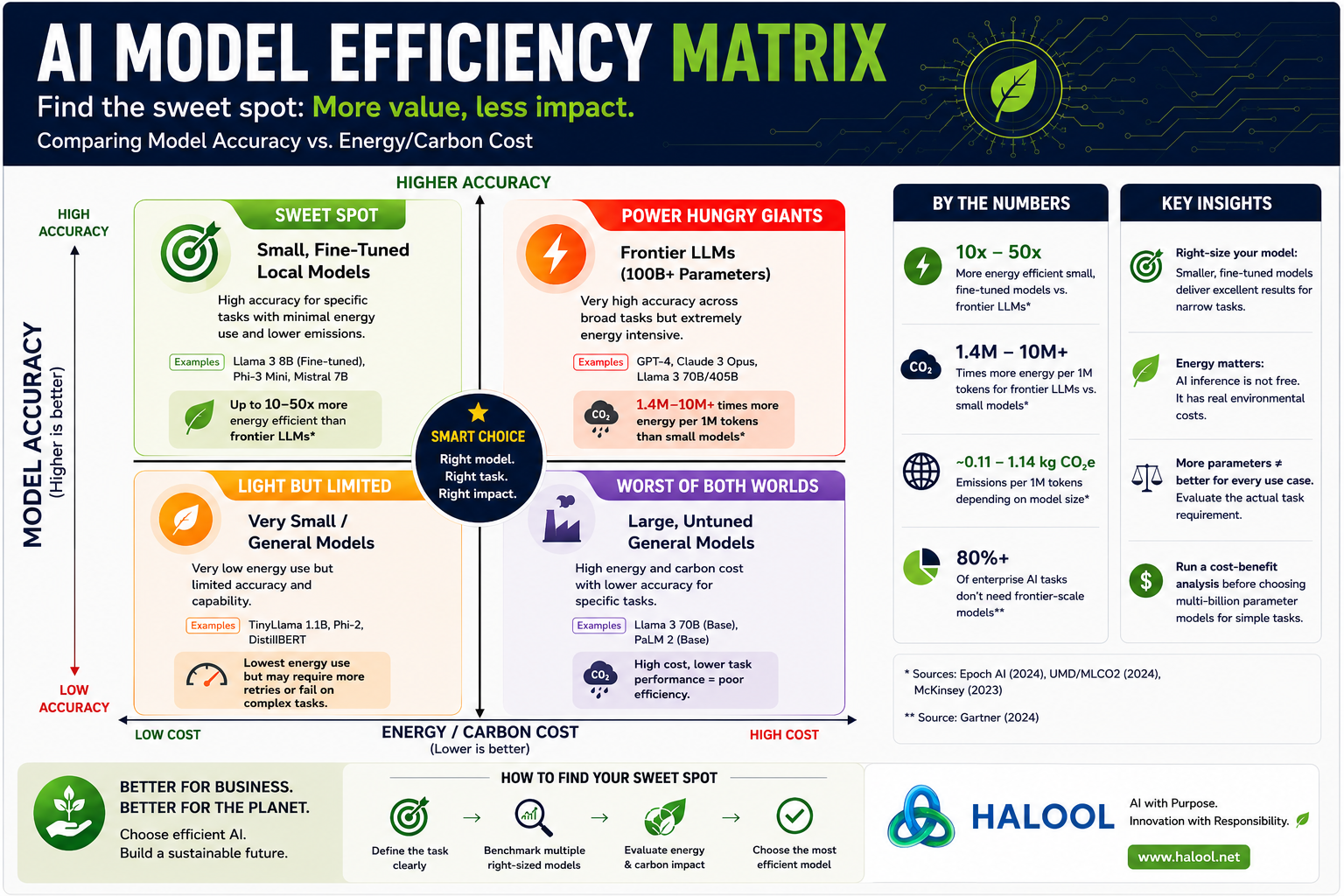
Large Language Models (LLMs) drive innovation but carry hidden energy and carbon costs. Recent studies show inference often dominates the lifecycle footprint of LLMs, far beyond the one-time training cost. A single query to a state-of-the-art model now consumes on the order of 0.2–1.0 watt-hours (Wh). Scaled to millions of daily users, this adds up to petawatt-hours per year and substantial CO₂ emissions.
However, a data-driven cost–benefit approach can sharply reduce this impact. Key strategies include choosing the right model size for the task, using techniques like distillation/quantization, scheduling inference under clean-energy hours, and measuring efficiency with robust KPIs. The net result is improved sustainability and cost savings without compromising accuracy.
Background: Why LLMs Use So Much Energy
LLMs like GPT-4, LLaMA-3, and others rely on massive neural networks running on power-hungry GPUs or TPUs. Both training and inference stages consume electricity:
Training: Building a large model requires enormous computation over weeks. Training GPT-3 (175B parameters) is estimated at 1,287 MWh and ~550 metric tons CO₂ — a one-time cost amortized across the model's lifetime.
Inference: Every user query triggers GPU computations plus data-center overhead. Inference can now account for >50–90% of an LLM's total lifecycle energy because services run continuously, day and night.
Why so high? Modern GPUs run near their power limit (250–400W) during inference, even when utilization isn't 100%. Additional factors:
Memory access & latency: Large models often bottleneck on memory bandwidth, leading to inefficient GPU use.
Inference overheads: Idle or under-utilized hardware (to meet latency targets) wastes power.
Data-center inefficiency: Typical PUE ~1.2–1.5 adds 20–50% overhead beyond compute itself.
Quantitative Estimates: Energy, Carbon, and Cost per Query
Energy per query: Google reports a median Gemini text query uses just 0.24 Wh — down 33× from a year earlier. Typical GPT-4 queries (~500 tokens) use around 0.3 Wh — about as much as an LED lamp for 15 minutes.
Carbon emissions: At ~0.42 kgCO₂/kWh, 0.3 Wh/query equals ~0.13 g CO₂. Google's detailed accounting estimates ~0.03 g CO₂ per Gemini query. On coal-heavy grids this can triple — and 700M GPT-4 queries/day equals the electricity of ~35,000 U.S. homes.
Model size scaling: On identical GPUs, DeepSeek v3 (405B) used ~0.35 Wh/query, Llama-3-70B used 0.083 Wh, Llama-2-13B used 0.025 Wh, and Llama-3-8B used only 0.0075 Wh — showing diminishing returns of scale.
Financial cost: GPT-3.5-turbo is $0.002 per 1,000 tokens; GPT-4 charges 5–10× more. Token pricing implicitly reflects underlying energy cost.
Small vs. Large Models: A Case Comparison
Simple/narrow tasks: Classification, FAQ answering, extraction, and short summaries rarely need 400B-parameter models. A well-tuned 7–13B model often matches a 70B+ model at <10% of the energy per query.
Case study: An internal HR Q&A chatbot on a 7B model may consume ~0.01 Wh per query, versus an order of magnitude more on a 100B+ flagship — savings multiply at scale.
When big is truly needed: Complex reasoning, long-context summaries, and creative generation may justify GPT-4-class models — but RAG and few-shot prompting can reduce dependency on raw size.
Cost–Benefit Framework and KPIs
Performance requirements: Define accuracy/capability targets (BLEU, F1) and only escalate to larger models when smaller ones consistently fail.
Energy & carbon metrics: Measure Wh per query, kWh per day/month, and CO₂ per correct answer.
Financial cost: Calculate $ per query from cloud pricing or local hardware, including idle and overhead costs.
Latency & throughput: Strict SLAs force small batches or extra servers — both impact energy.
Decision flow: Pilot small models first; escalate only when metrics demand it.
Example KPIs: queries per kWh; CO₂ per 1,000 responses; average GPU utilization; serving infrastructure PUE; % inference on renewable energy; accuracy-vs-energy ratio.
Best Practices for Reducing Impact
Model selection & specialization: Always start small. Use the smallest model that meets requirements; prefer fine-tuned or rule-based tools for trivial tasks.
Knowledge distillation: Train smaller student models that mimic a large teacher — often retaining most accuracy at 10× smaller size.
Quantization & pruning: 8-bit / 4-bit inference and weight pruning reduce memory/compute 2–4× with minimal accuracy loss.
Batching & parallelism: Aggregate queries into batches to maximize GPU utilization until latency limits kick in.
Efficient infrastructure: Deploy on modern GPU/TPU hardware with better performance-per-watt and low-PUE, renewable-rich data centers.
Carbon-aware scheduling: Shift non-urgent inference to cleaner grid hours or regions — up to ~70% renewable offset is achievable.
Edge vs. cloud: For small, frequently used models, run on-device or on-prem to avoid round-trip energy.
Renewable energy procurement: Invest in PPAs, on-site solar/wind, and carbon-goal cloud regions.
KPIs to Track Sustainability
Energy intensity: kWh per 1,000 requests or per inference.
Carbon intensity: kgCO₂ per inference, using grid-mix or carbon accounting tools.
Model efficiency: accuracy per kWh, tokens per gram CO₂.
Resource utilization: GPU/CPU utilization, data-center PUE, % time on clean energy.
Cost efficiency: $ per query vs. energy usage — identifying idle servers and redundant models.
Conclusion and Actionable Checklist
LLMs offer powerful capabilities, but unchecked use can hide significant energy and carbon costs. A strategic, data-driven approach lets organizations leverage generative AI responsibly.
Task fit: Benchmark small/mid models first. Avoid one-size-fits-all giants.
Measure & monitor: Instrument pipelines with energy/emissions tracking (codecarbon, Cloud Carbon Footprint). Report monthly.
Optimize models: Apply distillation, pruning, and quantization routinely. Evaluate MoEs and mixtures.
Batch & schedule: Tune batch sizes and run non-urgent jobs during low-carbon hours.
Lean infrastructure: Use latest hardware, prefer green regions or on-prem green power. Turn off idle GPUs.
Carbon goals: Set explicit targets (e.g., AI CO₂ per query < X grams) and tie model choices to them in architecture reviews.
Responsible AI isn't just an ethical choice — it's smart resource stewardship and cost control.
For contractual research, analysis, and data-driven insights, write to us at info@halool.net