
Pakistan is home to more than 265 million people, making it one of the world's most populous nations. Yet behind this large population lies a highly uneven socio-economic structure characterized by significant differences in income, wealth, opportunity, and institutional influence.
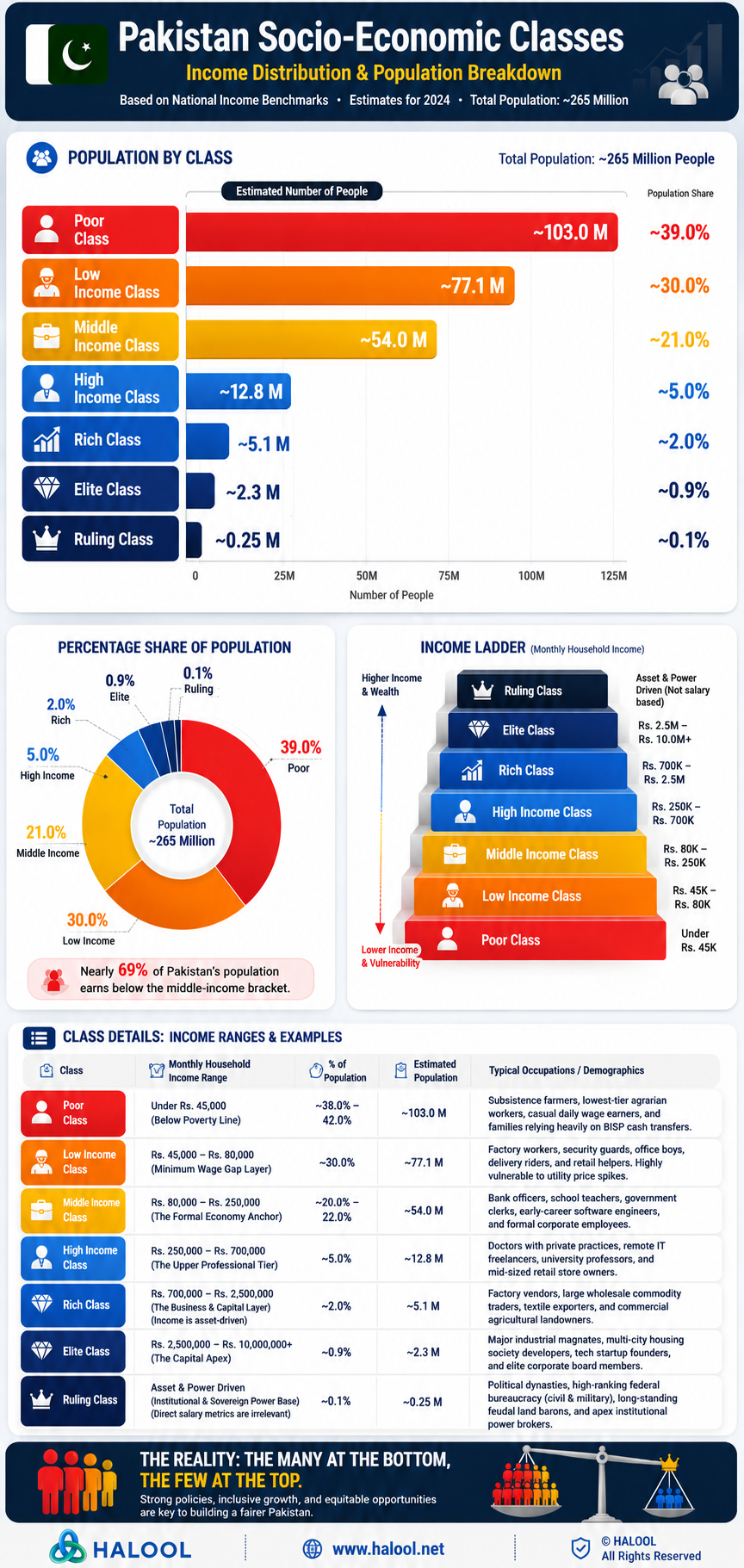
To better understand these dynamics, Halool has developed a visual overview of Pakistan's socio-economic class stratification based on household income ranges, population estimates, and occupational characteristics.
The Pyramid of Pakistani Society
The infographic reveals a classic socio-economic pyramid.
At the base are the Poor and Low-Income classes, representing nearly 69% of the total population. These households often face economic vulnerability, limited savings, inflationary pressures, and restricted access to quality services.
The Middle-Income class forms the next layer, accounting for roughly one-fifth of the population. This group includes teachers, government employees, banking professionals, early-career engineers, and formal-sector workers who serve as a critical engine of economic productivity and social stability.
Above them lies the High-Income class, comprising skilled professionals, successful entrepreneurs, private practitioners, and experienced specialists.
The Rich and Elite classes represent a comparatively small portion of society. Their income and wealth are increasingly derived from assets, business ownership, capital appreciation, real estate holdings, and investment portfolios rather than traditional salaries.
At the apex stands the Ruling Class, defined less by income and more by institutional influence, political authority, strategic networks, and control over key public and private resources.
Key Findings
1. Lower-Income Groups Dominate the Population
The most significant observation is that the majority of Pakistanis remain concentrated in lower-income categories.
This concentration highlights the ongoing challenges of poverty reduction, wage growth, productivity enhancement, and social mobility.
2. The Middle Class Remains Relatively Limited
Globally, strong and expanding middle classes are often associated with stable democracies, sustainable consumption patterns, innovation, and economic resilience.
Pakistan's middle-income segment remains comparatively modest, indicating substantial room for economic advancement.
3. Wealth Concentration Increases Toward the Top
As income levels rise, population sizes decrease dramatically.
This pattern reflects the concentration of wealth, assets, capital ownership, and influence among increasingly smaller groups.
4. Economic Mobility Matters
The long-term success of any nation depends not only on economic growth but also on the ability of citizens to move upward through education, skills development, entrepreneurship, and productive employment.
Implications for Policymakers and Businesses
Several strategic priorities emerge from this analysis:
Strengthening quality education and workforce development.
Expanding access to healthcare and nutrition.
Encouraging entrepreneurship and SME growth.
Supporting industrial productivity and exports.
Enhancing financial inclusion.
Creating pathways for upward social mobility.
Expanding opportunities for women and youth participation in the economy.
Conclusion
Pakistan's socio-economic landscape presents both challenges and opportunities. While the majority of citizens remain within lower-income categories, a growing middle class and expanding knowledge economy offer significant potential for transformation.
Understanding these realities is essential for policymakers, businesses, researchers, development practitioners, and citizens alike.
At Halool, our mission is to transform data into actionable insights that support informed decision-making and sustainable development.
For contractual research, analysis, and data-driven insights, write to us at info@halool.net