
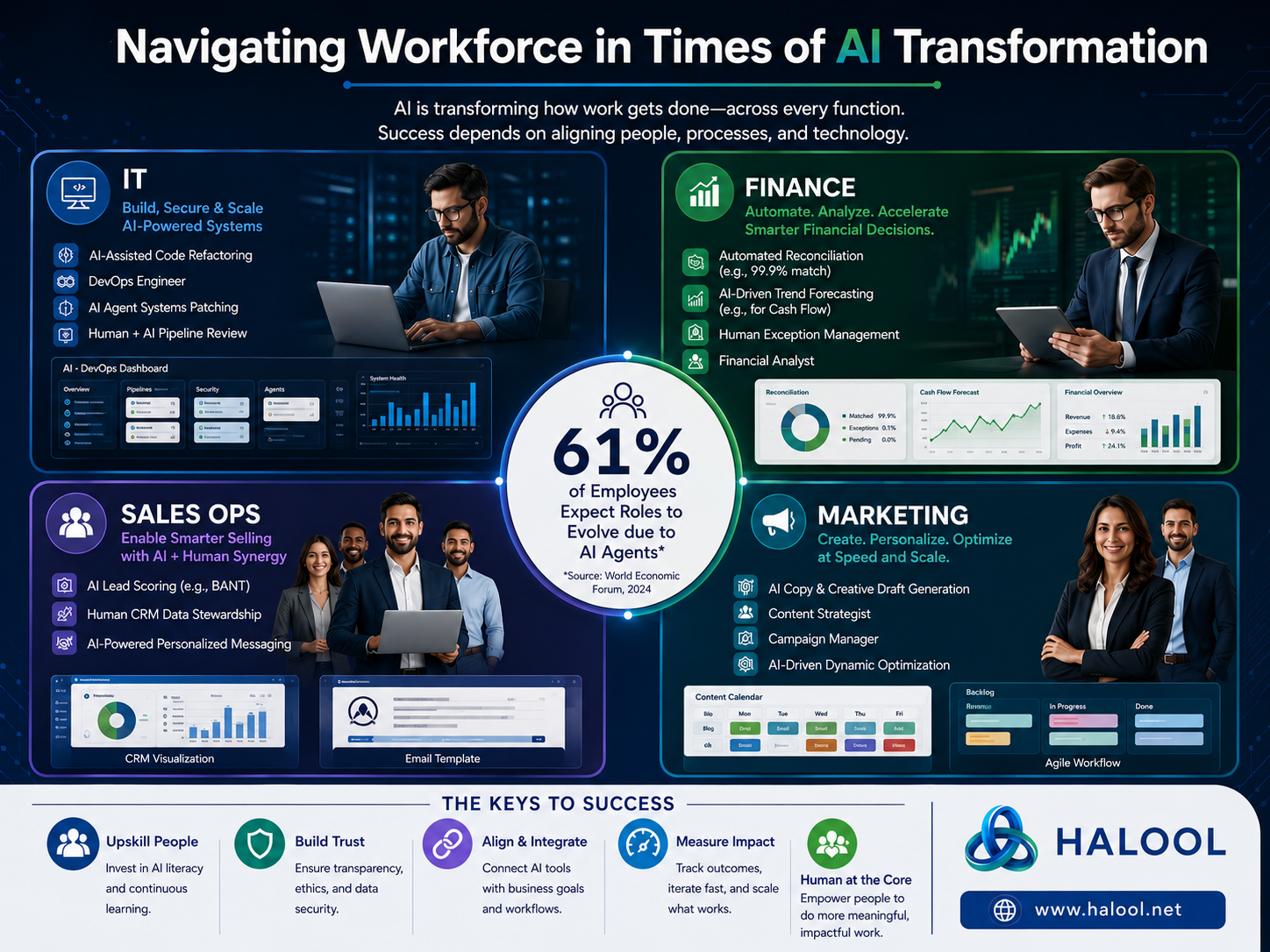
Artificial intelligence has moved beyond experimentation into systemic integration across industries. According to the World Economic Forum, 86% of employers expect AI to transform their businesses by 2030, signaling a foundational restructuring of work itself.
1. The Scale of Workforce Disruption and Opportunity
Recent global research highlights the dual nature of AI's workforce impact:
40% of workers require reskilling within three years (WEF)
Two-thirds of jobs are exposed to automation or augmentation
AI could automate a significant share of work tasks, though full job replacement remains limited
McKinsey research further estimates:
~12% of tasks are already automated in practice
Up to 58% of work activities are technically automatable, depending on context
This gap between capability and adoption creates a critical strategic window for enterprises.
2. From Job Displacement to Task Reconfiguration
The dominant misconception is that AI replaces jobs wholesale. In reality, leading research shows a different mechanism:
AI decomposes work into three categories: fully automatable tasks, AI-assisted tasks, and human-only judgment tasks. Most roles today are becoming hybrid structures rather than eliminated positions.
PwC's large-scale analysis of over 500 million job postings confirms a shift toward:
AI literacy requirements
Analytical augmentation
Prompt-based and generative workflows
Reduced emphasis on repetitive manual execution
3. Enterprise Case Reality: Hybrid Workforce Models
A major consulting firm (McKinsey disclosure, 2026) reported a real-world transformation:
Expansion of client-facing, high-value roles (~25%)
Reduction of non-client-facing operational roles (~25%)
Deployment of thousands of AI agents operating alongside human employees
This demonstrates an emerging model: the workforce is evolving into a human-AI co-execution system, not a replacement cycle.
4. Key Strategic Risks for Organizations
Despite rapid adoption, multiple structural gaps remain:
Only a minority of firms have scaled reskilling programs effectively
Many AI initiatives fail to deliver measurable ROI
Entry-level role erosion risks long-term talent pipeline collapse
These risks indicate that AI transformation is not primarily technical — it is organizational.
5. Strategic Imperatives for Leadership
To remain competitive, organizations must focus on five capability shifts:
Workforce Upskilling at Scale — AI literacy must become a baseline competency.
Workflow Redesign — AI must be embedded into processes, not added as a tool.
Human-AI Role Architecture — Clear delineation of judgment vs execution tasks.
Measurement of AI Impact — Focus on productivity per workflow, not per headcount.
Human-Centric Value Preservation — Creativity, ethics, and decision-making remain strategic differentiators.
Conclusion: The Competitive Advantage Equation
AI transformation is no longer about automation capability — it is about organizational adaptability.
The next generation of high-performing enterprises will not be those that deploy AI fastest, but those that redesign work intelligently, reskill continuously, and orchestrate human + AI systems as one integrated operating model.
The workforce is not shrinking. It is being re-coded.
At Halool, we help organizations navigate this transition with clarity — combining strategic insight, digital transformation expertise, and workforce development frameworks tailored to your reality.
For contractual research, analysis, and data-driven insights, write to us at info@halool.net