
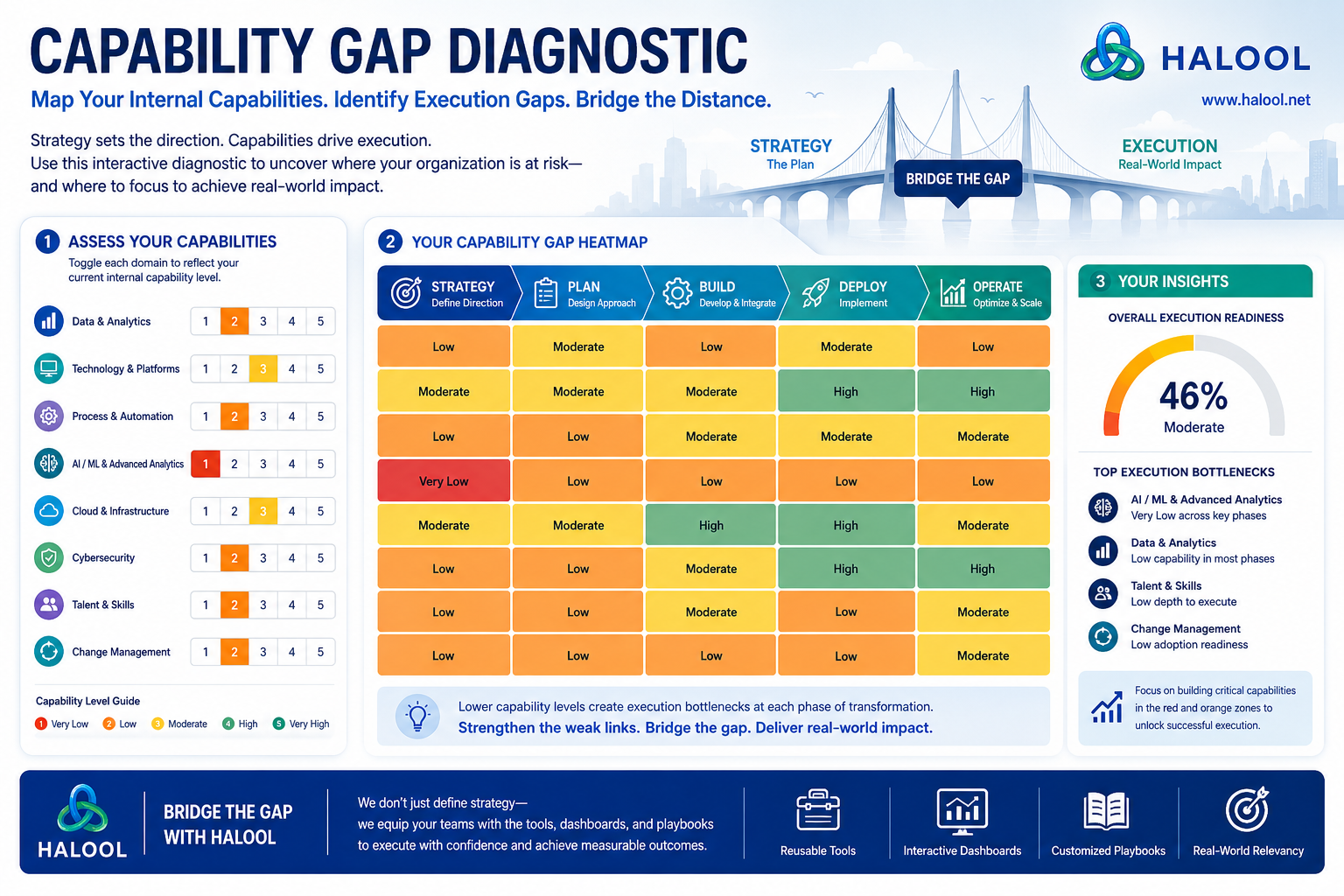
Organizations frequently find that great strategies sputter when moved into the real world. Studies show roughly two-thirds to 90% of strategies fail in execution, leaving leadership frustrated and goals unmet. The root causes range from leadership misalignment and siloed structures to outdated metrics and skill gaps.
This report examines why the strategy–execution gap persists and how to close it. We synthesize recent consulting and academic research to highlight critical barriers (fragmented accountability, rigid governance) and high-impact enablers (integrated leadership, AI-driven monitoring). The evidence shows that closing this gap requires a disciplined, data-driven approach and a culture of accountability. By adopting these frameworks and capabilities, Halool and its clients can ensure that strategic plans translate into concrete outcomes.
Understanding the Strategy–Execution Gap
The strategy–execution gap is the disconnect between high-level plans and what actually happens day to day. In one survey, only 16% of top managers believed their strategic initiatives succeeded, and just 56% of initiatives met original goals. PMI found 35% of leaders point to a disconnect between planning and execution as the top barrier. Kaplan and Norton famously estimate 67–90% of strategies fail due to execution issues.
Leadership misalignment and structure: Fragmented leadership and rigid hierarchies block fast decision-making and accountability.
Poor communication and culture: Unclear cascading of priorities and cultural resistance prevent initiatives from taking hold.
Skills and resource gaps: Outdated skills, weak digital expertise, and insufficient analytics slow implementation.
Lack of governance and metrics: Without clear ownership, tracking, and balanced KPIs, progress drifts and early warnings are missed.
Evidence and Case Studies
Food & Beverage Distributor (BrightOrg, 2026): Consultants translated a 3–5 year vision into 22 measurable enterprise goals with owners, RACI roles, and real-time dashboards. Within six months, 100% of strategic goals were tracked in real time and teams embraced shared ownership. Takeaway: build formal governance and transparent KPI tracking; every initiative needs a clear owner.
Manufacturing Digital Transformation (Chinese Brewery, 2026): Top-down standards without frontline input widened the execution gap — workers created workarounds and management doubled down on surveillance. Lesson: without credible two-way feedback, rigid governance causes disengagement.
Enterprise Tech Firm (RGP, 2023): High performers built a Dynamic Workforce blending 50% internal staff and 50% external experts. Their market cap rose 54% over five years, while the poorest executors' fell 21%. Insight: tap outside talent as tiger teams to accelerate execution and transfer capability.
Role of Skills, Teams and Culture
Bridging the gap is as much a people challenge as a technical one. PMI's research notes that outdated skills and centralized decision-making slow strategy delivery. Structured training plans — from strategy execution workshops to data literacy courses — are essential deliverables.
Culture and leadership behaviors are paramount. Employees need to see how their daily work ties to corporate goals. Recognition of execution wins builds momentum. Regular review forums reinforce ownership, and a continuous-feedback culture turns an execution plan into an adaptive process — echoing PMI's M.O.R.E framework (Manage perceptions, Own success, Reassess constantly, Expand perspective).
Deliverables: Tools, Dashboards, Playbooks, Training
A deliverable portfolio typically includes analytical tools (forecasting models, scenario spreadsheets), dashboards (Power BI / Tableau visualizations), interactive playbooks (digital manuals covering roles, processes, escalation paths), and structured training curricula. Each deliverable should be reusable — built as a template or platform component the client can adapt over time.
Analytical Tools — Model scenarios and quantify trade-offs. High reuse potential; medium effort.
Dashboards — Visualize KPIs and track progress in real time. Medium reuse; medium-to-high effort.
Playbooks / Manuals — Embed processes, best practices, and roles. High reuse; medium effort.
Training Programs — Build skills and habits for execution. Medium reuse; medium-to-high effort.
Metrics and KPIs for Measuring Success
World-class organizations use a balanced-scorecard approach, tracking financial outcomes alongside drivers and enablers.
Financial outcomes: revenue growth, profit margin, return on capital.
Customer metrics: NPS, CSAT, market share, retention.
Operational efficiency: cycle times, quality rates, productivity.
Innovation impact: new products launched, revenue from new offerings, patents filed.
Employee engagement: on-time task completion, training completion, alignment survey scores.
Assign owners to each KPI and set a reporting cadence. Automated dashboards should flag underperformance with red/yellow/green indicators and link directly to action items.
Implementation Roadmap
Closing the gap is a change initiative in itself and requires a structured rollout — typically 6 to 12 months across four phases.
Phase 1 — Initiation: leadership alignment, governance setup, execution team and review cadence.
Phase 2 — Development: build dashboards, playbooks, data integrations, and analytic tools.
Phase 3 — Deployment: launch dashboards and playbooks, run training workshops, pilot initiatives, gather feedback.
Phase 4 — Sustain: continuous monitoring, monthly strategy reviews, and iterative adjustments.
Key roles: Executive Sponsor, Strategy Execution Lead / PMO manager, Data/IT lead, and Subject-Matter Experts from each business unit. Consultants develop and transfer tools; the internal team executes and feeds back results — forming a closed-loop handoff so the client becomes fully self-sufficient.
Risks and Mitigation
Leadership turnover or loss of focus — secure broad buy-in via a steering committee; embed execution into weekly/monthly operating rhythms.
Resource and skills gaps — build in dedicated training and coaching; extend on-site support where needed.
Data and technology issues — assess data readiness early; run a preliminary data-cleanup sprint if required.
Cultural resistance — engage stakeholders early, create quick wins, celebrate small milestones, deploy change champions.
Over-reliance on the consulting team — institute knowledge transfer from day one; measure internal adoption (dashboard logins, training results).
Conclusion
By rigorously applying clear accountability, real-time metrics, capable teams, and iterative governance, Halool clients can transform strategic plans into tangible results. The journey from strategy to execution may be complex, but it is both manageable and vital for sustained success.
For contractual research, analysis, and data-driven insights, write to us at info@halool.net